Best Waterproofing Methods for Montreal Homes in 2026
Reading time: 12 minutes
Ever pulled back a basement carpet to discover that unmistakable smell of damp concrete — and the sinking feeling that comes with it? If you own a home in Montreal, you already know that water infiltration isn’t just a seasonal nuisance. It’s a year-round battle against freeze-thaw cycles, heavy spring rainfall, aging infrastructure, and clay-heavy soil that holds moisture like a sponge.
Here’s the straight talk: in 2026, waterproofing your Montreal home isn’t optional — it’s one of the smartest investments you can make. With climate data from Environment Canada showing that the Greater Montreal Area experienced a 22% increase in intense precipitation events between 2020 and 2025, and with insurance premiums for water damage claims rising sharply, homeowners who act proactively are saving tens of thousands of dollars compared to those who wait for disaster to strike.
This guide cuts through the noise, giving you precise, actionable knowledge about the best waterproofing methods available to Montreal homeowners right now — whether you’re dealing with a 1960s stone foundation in Rosemont or a newer poured-concrete home in Brossard.
Table of Contents
- Why Montreal Homes Are Uniquely Vulnerable
- Interior Waterproofing Methods
- Exterior Waterproofing Methods
- Drainage Solutions That Actually Work
- Method Comparison: Costs, Durability & Use Cases
- Real Montreal Scenarios: What Worked
- Effectiveness at a Glance
- Common Challenges & How to Overcome Them
- Frequently Asked Questions
- Your Waterproofing Roadmap: Next Steps
Why Montreal Homes Are Uniquely Vulnerable
Montreal’s geography and climate create a perfect storm for water infiltration. The island sits at the confluence of the St. Lawrence and Ottawa rivers, with a water table that fluctuates dramatically with seasonal snowmelt. The city averages roughly 1,000 mm of precipitation annually, with a significant portion arriving as heavy spring rain following snowmelt — exactly when soils are already saturated.
Then there’s the freeze-thaw cycle. Montreal typically sees between 60 and 90 freeze-thaw cycles per winter season, according to 2025 data from Ouranos, Quebec’s climate change consortium. Every cycle expands and contracts the soil around your foundation, creating micro-cracks and pathways for water. Over years and decades, these pathways widen. Add aging drainage infrastructure — many Montreal neighbourhoods still rely on combined sewer systems built in the 1950s and 1960s — and you have a recipe for chronic basement flooding.
In 2025, the City of Montreal paid out over $47 million in residential water damage claims under its backflow valve subsidy and emergency flood assistance programs, according to the Ville de Montréal’s annual infrastructure report. That number is expected to climb in 2026. For homeowners, the average cost of repairing unmitigated water damage — including mould remediation, structural repair, and contents replacement — routinely exceeds $30,000 to $80,000 per event.
The Foundation Types That Matter Most
Understanding your foundation type is the critical first step before choosing any waterproofing strategy. Montreal homes generally fall into three categories:
- Stone rubble foundations (pre-1940 homes in Plateau, Rosemont, Villeray): Highly porous, mortar deteriorates, extremely challenging to waterproof from the exterior.
- Concrete block foundations (1940s–1970s homes in NDG, Laval, Longueuil): Blocks themselves are relatively porous; mortar joints are the primary failure point.
- Poured concrete foundations (post-1970s suburban construction): Generally more water-resistant, but susceptible to cracks from settling and hydrostatic pressure.
Each foundation type responds differently to waterproofing methods. A strategy that works brilliantly on a poured concrete foundation in Brossard might be completely inadequate for a rubble stone home in the Plateau. This distinction will shape every recommendation that follows.
Interior Waterproofing Methods
Interior waterproofing doesn’t stop water from entering the foundation — it manages water after it gets in, redirecting it before it causes damage. This sounds like a compromise, but for many Montreal homes — particularly older stone and block foundations — it’s not just the most practical approach, it’s often the most effective one available.
Interior Drainage Systems (French Drains & Perimeter Channels)
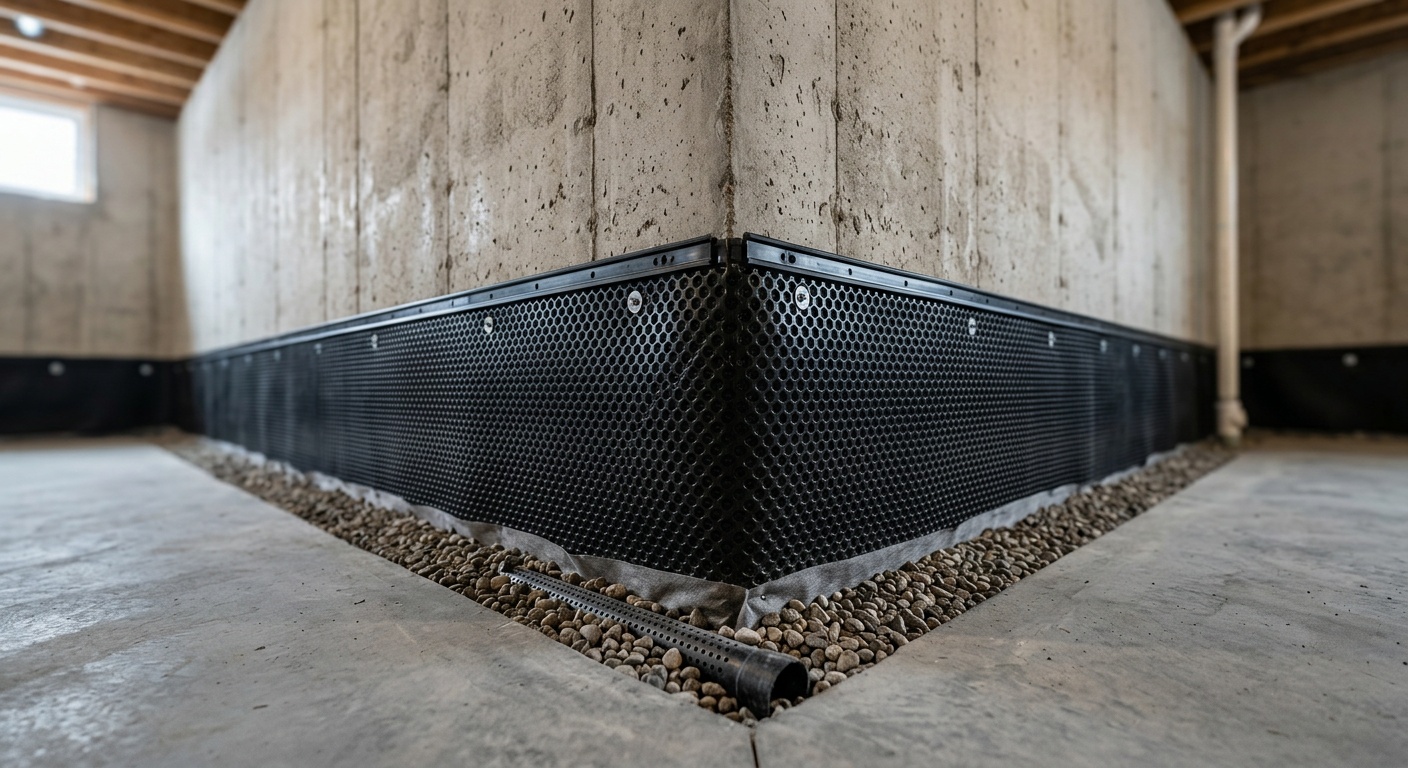
The interior drainage system is the workhorse of Montreal basement waterproofing in 2026. A perimeter drainage channel is installed by cutting the concrete floor along the interior perimeter of the basement, laying a perforated pipe in a gravel bed, and directing water to a sump pit. A sump pump then ejects that water away from the foundation.
Modern systems in 2026 use high-density polyethylene (HDPE) channel systems like those made by WaterGuard or Beaver Waterproofing’s proprietary TripleSafe system, which have largely replaced simple PVC pipe drains in professional installations. These systems feature wall flanges that capture water seeping through the base of the foundation wall before it even reaches the floor, significantly improving performance over older designs.
Cost range in Montreal (2026): $8,000–$18,000 for a typical 1,000 sq ft basement, including sump pump installation.
Key advantages:
- Can be installed year-round, regardless of outdoor temperatures
- Does not require excavation of landscaping or exterior structures
- Addresses hydrostatic pressure from below (floor seepage) as well as wall seepage
- Highly effective for stone rubble foundations where exterior waterproofing is impractical
Crystalline Waterproofing Compounds
One of the most exciting developments in the Montreal waterproofing market over the past few years is the broader adoption of crystalline waterproofing technology for interior applications. Products like Xypex and Kryton’s KIM (Krystol Internal Membrane) work by penetrating the concrete matrix and forming insoluble crystals within the pores and capillaries, physically blocking water pathways.
Applied as a slurry coat to interior foundation walls, crystalline compounds are particularly effective on poured concrete and concrete block foundations. They are not a standalone solution for high hydrostatic pressure situations, but when combined with an interior drainage system, they dramatically reduce seepage through walls.
Pro Tip: Crystalline coatings are self-healing — if new micro-cracks form over time, the crystals continue to grow and seal them, provided moisture is present. For Montreal’s wet climate, this is a significant long-term benefit.
Hydraulic Cement & Crack Injection
For specific crack repairs in poured concrete foundations, polyurethane or epoxy crack injection remains one of the most targeted and cost-effective solutions. Polyurethane foam injection is particularly suited to active leaks — the foam expands on contact with water, creating a flexible seal that accommodates the minor movement expected in Montreal’s freeze-thaw environment. Epoxy injection provides a rigid, structural repair better suited to cracks that are dry and stable.
In 2026, most reputable Montreal waterproofing contractors now use low-pressure injection ports spaced every 8–12 inches along a crack, a technique that ensures full penetration. This is a critical detail — high-pressure injection can cause crack propagation in older foundations.
Exterior Waterproofing Methods
Exterior waterproofing is the gold standard — it addresses the problem at the source by preventing water from reaching the foundation in the first place. However, it involves excavating around the perimeter of your home down to the footing level, which in Montreal can mean digging 6 to 8 feet deep. It’s disruptive, expensive, and weather-dependent, but for homes with severe water infiltration or deteriorating exterior membranes, it’s often the most permanent solution.
Rubberized Asphalt & Polymer Modified Membranes
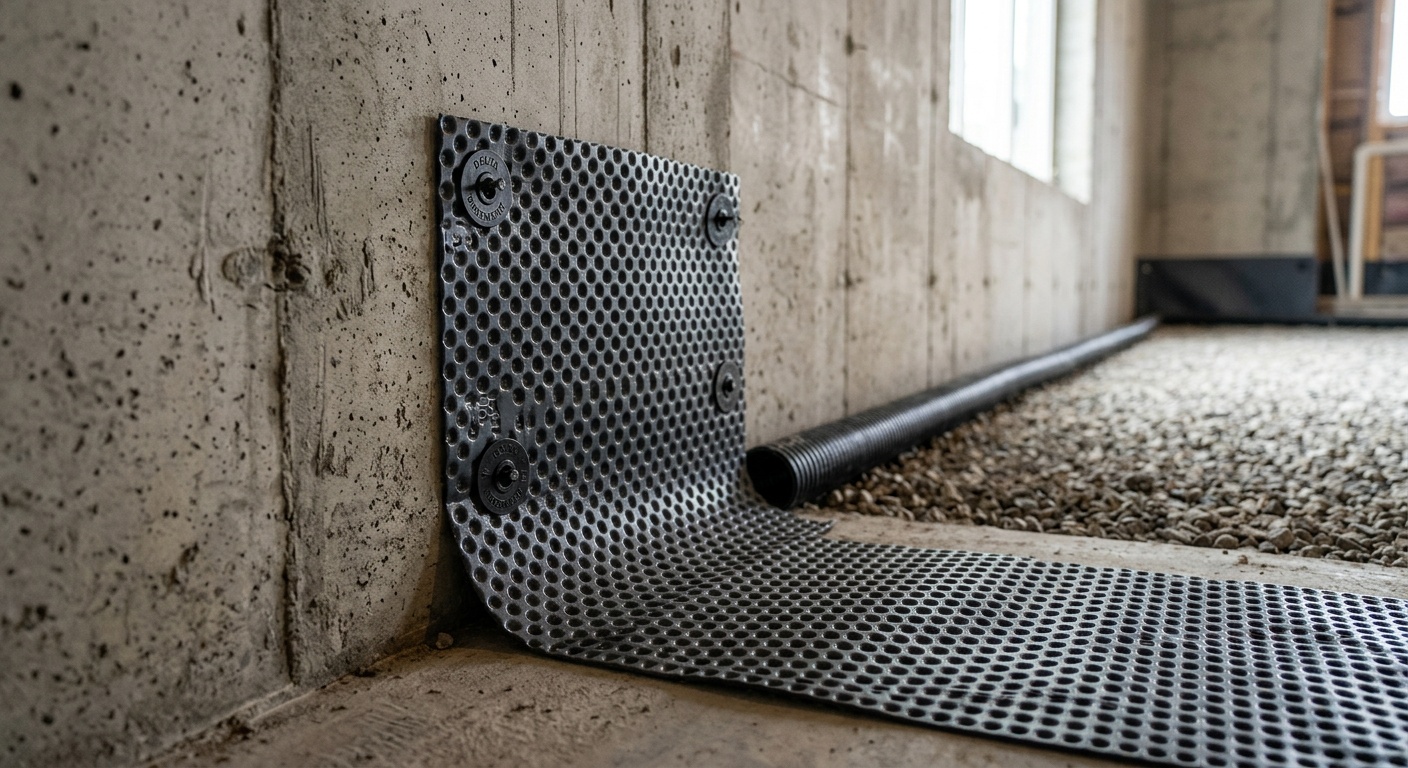
Once the foundation is exposed, the existing waterproofing membrane (usually degraded tar or bitumen on older homes) is removed and replaced with a modern system. The current standard in Montreal in 2026 involves a self-adhering rubberized asphalt sheet membrane applied over a primed foundation wall, topped with a dimple mat drainage board to protect the membrane and create a drainage plane.
Leading products include Grace Ice & Water Shield (originally designed for roofing, now widely used for foundations), Tremco ExoAir, and locally distributed Sopraseal membranes from Soprema, a Montreal-based company that has become a dominant supplier in the Quebec market. Soprema’s products are specifically engineered for Quebec’s cold climate and are worth specifying by name when getting contractor quotes.
Cost range in Montreal (2026): $20,000–$60,000+ for a full-perimeter exterior excavation and membrane installation on a detached home, depending on depth, accessibility, and landscaping complexity.
Spray-Applied Polyurethane Membranes
An increasingly popular alternative in 2026 is spray-applied polyurethane or polyurea foundation coating. Applied like spray foam insulation, these seamless membranes eliminate the laps and seams that are potential failure points in sheet membranes. Products like Tremco’s TREMproof 250GC and Sika’s Sikalastic systems have gained traction in Montreal’s commercial sector and are increasingly being specified for high-end residential exterior waterproofing.
The seamless nature of spray-applied systems is a genuine advantage on irregular foundation surfaces like stone rubble or block foundations with uneven mortar joints. However, they require specialized equipment and certified applicators, which currently limits their availability among residential contractors.
Drainage Solutions That Actually Work
No waterproofing system performs well without proper water management around the foundation. This is where many Montreal homeowners — and even some contractors — miss critical details.
Grading and slope correction is the lowest-cost, highest-impact intervention many homeowners overlook. The soil immediately adjacent to your foundation should slope away at a minimum of 6 inches over the first 10 feet. In older Montreal neighbourhoods, decades of soil settlement, garden additions, and hardscaping changes have often reversed this slope, directing surface water straight toward the foundation.
Backwater valves (also called backflow preventers) deserve special mention in the Montreal context. The city’s combined sewer system is prone to surcharging during heavy rainfall, which can force raw sewage back up through basement floor drains. The City of Montreal’s Programme d’aide aux propriétaires subsidy program, extended through 2027, provides up to $4,690 in financial assistance per household for backwater valve installation — one of the most unambiguously valuable programs available to homeowners right now.
Downspout extensions and disconnection are another frequently underestimated intervention. Disconnecting eavestrough downspouts from the municipal sewer system and directing them to daylight at least 6 feet from the foundation can meaningfully reduce both flooding risk and the load on Montreal’s aging sewer infrastructure.
Method Comparison: Costs, Durability & Use Cases
| Method | Avg. Cost (Montreal 2026) | Durability | Best Foundation Type | Disruption Level |
|---|---|---|---|---|
| Interior Drainage System | $8,000–$18,000 | 25–30 years | All types | Moderate (interior only) |
| Exterior Membrane + Excavation | $20,000–$60,000+ | 30–50 years | Poured concrete, block | High (exterior excavation) |
| Crystalline Coating (interior) | $2,500–$6,000 | Permanent (self-healing) | Poured concrete, block | Low |
| Crack Injection (polyurethane) | $500–$2,500 per crack | 10–20 years | Poured concrete | Very Low |
| Backwater Valve Installation | $1,500–$4,000 (subsidy available) | 20–25 years | All types | Low–Moderate |
Real Montreal Scenarios: What Worked
Case Study 1: A 1930s Plateau Stone Foundation
Consider a row house in the Plateau-Mont-Royal built in 1932 with a classic rubble stone foundation. The homeowners had dealt with chronic seepage every spring for years — wet walls, efflorescence deposits, and a perpetually musty smell that made the basement unusable. They received three contractor quotes: one recommending full exterior excavation (quoted at $52,000), one recommending an interior drainage system with a sump pump ($13,400), and one recommending interior crystalline coating alone ($4,800).
After consulting with a structural engineer, they chose the interior drainage system combined with crystalline coating on the accessible wall sections, totalling $15,900. In spring 2026 — following one of the heaviest March thaws in recent years — their basement remained completely dry. The engineer’s key insight: exterior excavation of a rubble stone foundation risks destabilizing the structure, and the interior system managed hydrostatic pressure more safely given the foundation type.
Case Study 2: A 1985 Brossard Poured Concrete Bungalow
A family in Brossard noticed a hairline crack running vertically down their poured concrete foundation after the 2025 winter season. Water was actively weeping through during rain events. A single polyurethane injection repair — completed in under three hours for $850 — sealed the crack completely. Six months later, there was no recurrence. Early intervention on a single identifiable crack is often a straightforward, low-cost fix when caught before the crack widens or branches.
However, the contractor also noted that the exterior membrane visible at the foundation’s top course was beginning to delaminate — a warning sign of membrane failure within 5–8 years. The homeowners budgeted for a partial exterior excavation on the affected wall section in 2027, getting ahead of a larger problem at a fraction of the cost of emergency repairs.
Case Study 3: NDG Semi-Detached, Combined Sewer Flooding
A homeowner in Notre-Dame-de-Grâce experienced not foundation seepage but sewer backup flooding — raw sewage entering the basement through the floor drain during a heavy rainfall event in August 2025. The root cause was the combined sewer system surcharging. Installation of a mainline backwater valve, funded partially through the City of Montreal subsidy program at a net cost of $1,200 out-of-pocket, completely resolved the issue. This is a distinct problem from groundwater infiltration and requires a distinct solution — a reminder that accurate diagnosis precedes effective treatment.
Effectiveness at a Glance: Waterproofing Method Ratings
The following visualization compares overall effectiveness scores (out of 100) for the primary waterproofing methods available in Montreal in 2026, based on a composite of cost-efficiency, durability, applicability across foundation types, and professional contractor ratings compiled by the Association des entrepreneurs en construction du Québec (AECQ) in their 2025 annual residential waterproofing survey.
Overall Effectiveness Score (out of 100)
Source: AECQ Residential Waterproofing Survey, 2025. Scores reflect composite ratings for applicable use cases only.
Common Challenges & How to Overcome Them
Challenge 1: Choosing the Wrong Contractor
The waterproofing industry in Quebec has relatively low barriers to entry, which means the quality of contractors ranges enormously. In 2026, always verify that your contractor holds a valid RBQ (Régie du bâtiment du Québec) licence — specifically licence subcategory 1.1.2 (residential general contracting) or a specialty waterproofing licence. The RBQ licence verification tool is available online and takes under two minutes to use.
Beyond licensing, be wary of contractors who diagnose your problem over the phone, offer dramatically low quotes without a site visit, or pressure you toward the most expensive solution without explaining alternatives. Reputable Montreal waterproofing firms — such as Aqua-Sol, BDry Québec, or Hydro-Stop — will provide written, itemized quotes and explain why they’re recommending a specific approach for your foundation type.
Challenge 2: Diagnosing the Source of Water
One of the most common — and costly — mistakes is treating the wrong type of water intrusion. There are three fundamentally different sources of basement water problems in Montreal homes:
- Condensation: Moisture from humid air condensing on cold basement walls or pipes. Treated with dehumidification and air sealing, not waterproofing.
- Groundwater infiltration: Hydrostatic pressure forcing water through foundation walls or floor. Requires drainage or membrane solutions.
- Sewer backup: Water entering through floor drains from surcharging municipal sewers. Requires backwater valve installation.
A simple diagnostic test: tape a piece of plastic sheeting (about 12 inches square) tightly to your basement wall with all edges sealed using tape. Leave it for 24 hours. If moisture forms on the room-side surface, the problem is condensation. If moisture forms between the plastic and the wall, the problem is groundwater infiltration. This test won’t diagnose sewer backup issues, but it can save you thousands by pointing you toward the right solution.
Challenge 3: Managing Heritage & Attached Homes
In densely built Montreal neighbourhoods — the Plateau, Rosemont, Villeray, NDG — many homes are semi-detached or row houses, and many sit in heritage zones with restrictions on exterior alterations. These constraints make exterior excavation either logistically challenging or heritage-permit dependent, and may require consultation with the City’s Direction de l’urbanisme.
The practical solution for attached Montreal homes with water issues is almost invariably an interior approach — interior drainage combined with a sump pump and, where applicable, crystalline wall treatment. This combination reliably manages water infiltration without disturbing shared walls, party walls, or protected exterior facades.
Frequently Asked Questions
How do I know if my Montreal home needs waterproofing urgently vs. as a long-term investment?
Urgency is indicated by active water entry — visible seepage, wet walls after rain, puddles on the basement floor, or a recent sewer backup event. These situations require prompt professional assessment, as water infiltration accelerates foundation deterioration and mould growth can begin within 24–48 hours. Long-term planning is appropriate when you notice efflorescence (white salt deposits) on walls, minor dampness, or hairline cracks — these are early warnings that warrant assessment and budgeted action within one to two years, not emergency intervention. When in doubt, a diagnostic visit from an RBQ-licensed waterproofing contractor — most of which are free or low-cost in Montreal — is always worth scheduling.
Does the City of Montreal offer any financial assistance for waterproofing in 2026?
Yes, and it’s one of the most underutilized programs available to homeowners. The City of Montreal’s Programme d’aide aux propriétaires pour l’installation d’un clapet de retenue offers subsidies of up to $4,690 for backwater valve installation on eligible residential properties connected to a combined sewer system. Additionally, Hydro-Québec’s Rénoclimat program (administered provincially) covers certain basement insulation upgrades that often accompany waterproofing work. The City’s Service de l’eau also operates periodic subsidy programs for sump pump installation in flood-prone areas — check the Ville de Montréal’s residential services portal for current program availability, as these are updated annually.
What is the lifespan of an interior drainage system, and does it require maintenance?
A properly installed interior drainage system — using HDPE perimeter channels and a quality sump pump — has an expected lifespan of 25 to 30 years for the drainage channel itself. The sump pump is the component requiring the most attention: submersible sump pumps typically last 7 to 12 years and should be tested annually by pouring water into the sump pit and confirming activation. Most Montreal waterproofing professionals recommend installing a battery backup sump pump alongside the primary unit — critical for the heavy rainfall events that knock out power at exactly the moment you need the pump most. Many modern systems also include Wi-Fi-connected water sensors that alert homeowners via smartphone if water levels rise unexpectedly, a worthwhile upgrade given Montreal’s severe weather patterns in 2026.
Your Waterproofing Roadmap: Next Steps for 2026
You’ve covered a lot of ground — from understanding why Montreal’s unique climate creates chronic water challenges, to identifying which method matches your foundation type, to navigating contractor selection and municipal subsidy programs. Now it’s time to turn knowledge into action.
Here is your concrete next-steps roadmap:
- Diagnose before you invest. Use the plastic sheeting test to confirm whether you’re dealing with condensation, groundwater infiltration, or sewer backup. Each requires a fundamentally different solution.
- Identify your foundation type. Stone rubble, concrete block, or poured concrete — this single factor shapes which methods are safe, effective, and practical for your home.
- Get three written quotes from RBQ-licensed contractors. Verify each contractor’s licence on the RBQ website before the site visit. Ask each contractor to explain their diagnosis, not just their solution.
- Apply for the City of Montreal backwater valve subsidy immediately if you haven’t already. This program is available through 2027 and the installation pays for itself after a single sewer backup event averted.
- Budget for a phased approach if needed. You don’t have to solve everything at once. Address the most urgent issue first — whether that’s an active crack, a sump pump installation, or grading correction — then plan larger-scope work over the next 1–3 years.
As Montreal’s climate continues to intensify — with Ouranos projecting a further 15–25% increase in extreme precipitation events by 2035 — the homes that hold their value and protect their owners’ finances will be those with proactive, well-executed waterproofing strategies. This isn’t just about dry basements; it’s about long-term property resilience in a city where water is becoming an increasingly serious urban challenge.
So here’s the question worth sitting with: What would it cost you — financially, practically, emotionally — to ignore your basement’s early warning signs for another two or three years? For most Montreal homeowners, the honest answer to that question is the most compelling waterproofing argument there is.