Complete Guide to Waterproofing Your Montreal Home Basement
Reading time: 18 minutes
Montreal homeowners know this story all too well: you head downstairs one spring morning after the snowmelt, and you find a damp carpet, musty air, and a thin film of water creeping across the floor. It’s not just inconvenient — it’s a warning sign that your basement is fighting a losing battle against one of Canada’s most demanding climates. The good news? With the right waterproofing strategy, you can stop that battle before it costs you tens of thousands of dollars in structural repairs and mold remediation.
This guide is your straight-talking, no-fluff roadmap to understanding, planning, and executing basement waterproofing in Montreal’s unique environment. Whether you’re a first-time homeowner in Rosemont or a seasoned property investor in NDG managing a century-old triplex, this guide will help you turn a damp problem into a permanently dry solution.
Table of Contents
- Why Montreal Basements Are Uniquely Vulnerable
- Warning Signs You Should Never Ignore
- Waterproofing Methods Explained
- Interior vs. Exterior Waterproofing
- Costs and What to Expect in 2026
- DIY vs. Professional Waterproofing
- Real Montreal Case Studies
- Frequently Asked Questions
- Your Dry Basement Roadmap: Next Steps
Why Montreal Basements Are Uniquely Vulnerable
Let’s start with the honest truth: Montreal’s climate is practically engineered to destroy basement waterproofing. The city experiences an average of 1,000 mm of precipitation annually, with heavy spring melts from snowpack that can exceed 150 cm in harsh winters. According to Environment and Climate Change Canada’s 2025 regional report, the Greater Montreal area has seen a 12% increase in extreme rainfall events over the past decade — a trend that urban planners and homeowners alike cannot afford to ignore in 2026.
But precipitation is only half the problem. Montreal’s famous freeze-thaw cycle — which can cycle 30 to 40 times per winter — causes soil around foundations to expand and contract repeatedly. This relentless movement creates micro-cracks in concrete and masonry, turning even a well-built foundation into a sponge over time. Add to this the fact that nearly 40% of Montreal’s residential housing stock was built before 1970 using rubble stone or early poured-concrete foundations, and you have a recipe for chronic moisture intrusion.
The Geology Factor
Montreal’s island geography adds another layer of complexity. Much of the island sits on clay-heavy soil with relatively high water table levels, particularly in neighborhoods close to the St. Lawrence River and Rivière des Prairies. Clay soil expands dramatically when wet, pressing hydrostatic pressure against basement walls with surprising force. In some East End neighborhoods like Mercier and Anjou, water tables have risen measurably due to increased urbanization and reduced natural drainage — a pattern confirmed by the Ville de Montréal’s 2025 drainage infrastructure audit.
The Age of Montreal’s Housing Stock
A significant challenge unique to Montreal is the sheer age and variety of its residential foundations. Walk down any street in Plateau-Mont-Royal or Villeray, and you’ll encounter triplex and duplex buildings from the early 1900s with rubble stone foundations — beautiful architecturally, but notoriously porous. These structures were never designed with modern waterproofing in mind. Meanwhile, post-war bungalows in Côte-Saint-Luc and Saint-Laurent feature early poured concrete that is now reaching the end of its service life. Understanding your foundation type is step one in building any effective waterproofing plan.
Warning Signs You Should Never Ignore
Basement water problems rarely announce themselves with a dramatic flood. They whisper first — and most homeowners don’t hear them until significant damage has already occurred. Here are the warning signs that demand immediate attention:
- Efflorescence: White, chalky deposits on concrete or masonry walls. This is mineral residue left behind as water passes through and evaporates — proof that moisture is actively migrating through your walls.
- Musty or earthy odors: The unmistakable smell of mold or mildew is a serious red flag. According to Health Canada’s 2025 Indoor Air Quality guidelines, basement mold exposure is linked to respiratory conditions and should be addressed within 48 hours of discovery.
- Staining and rust marks: Brown or orange streaking on walls indicates water has been carrying iron deposits through cracks over an extended period.
- Cracks in walls or floors: Horizontal cracks in concrete block walls are particularly alarming — they signal lateral soil pressure and potential structural compromise.
- Peeling paint or bubbling drywall: If your basement is finished, these cosmetic symptoms often hide significant moisture problems behind the surface.
- Window condensation or rust on metal components: Excessive humidity is collecting somewhere, and your basement’s mechanical systems and structural elements are paying the price.
- Sump pump running constantly: If your sump pump cycles every few minutes, your foundation is under active hydrostatic pressure that a pump alone cannot solve long-term.
Quick Scenario: Imagine you notice a faint musty smell every spring but no visible water. Many Montreal homeowners dismiss this as “normal basement smell.” In reality, that odor almost always indicates hidden moisture accumulation — often behind walls, under flooring, or in the rim joist area. By the time you see staining or mold, remediation costs can be two to three times higher than early intervention.
Waterproofing Methods Explained
Not all waterproofing is created equal, and the right method depends heavily on your foundation type, the source of moisture, and your budget. Here’s a breakdown of the primary approaches used by Montreal contractors in 2026:
Crack Injection
For isolated cracks in poured concrete foundations, polyurethane or epoxy crack injection is often the most targeted and cost-effective solution. Polyurethane foam expands to fill the crack entirely and remains flexible — ideal for cracks that may still experience minor movement due to freeze-thaw cycles. Epoxy injection, by contrast, creates a rigid, structural bond and is best for non-moving cracks where structural reinforcement is needed. In 2026, most Montreal waterproofing specialists recommend polyurethane for residential applications given the city’s thermal cycling.
Interior Drainage Systems (Weeping Tile)
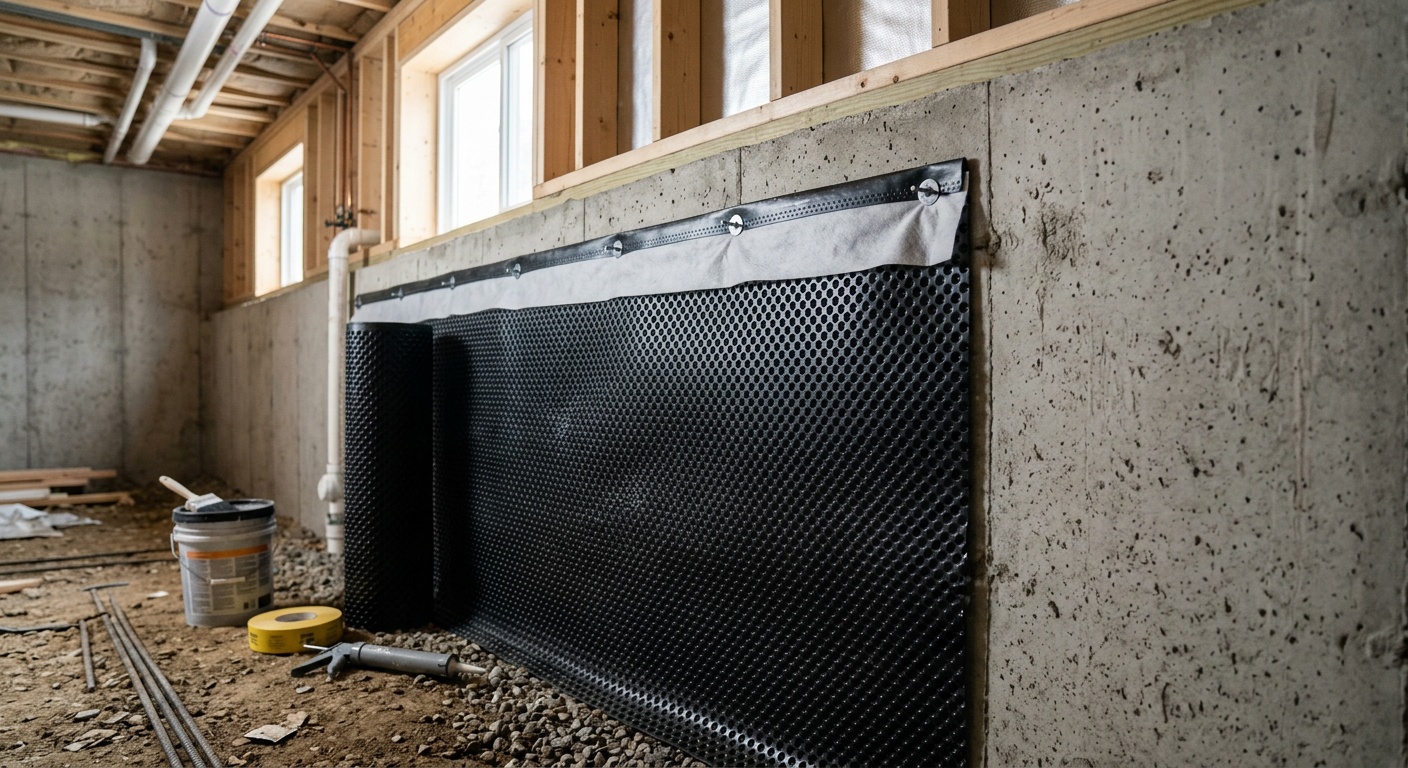
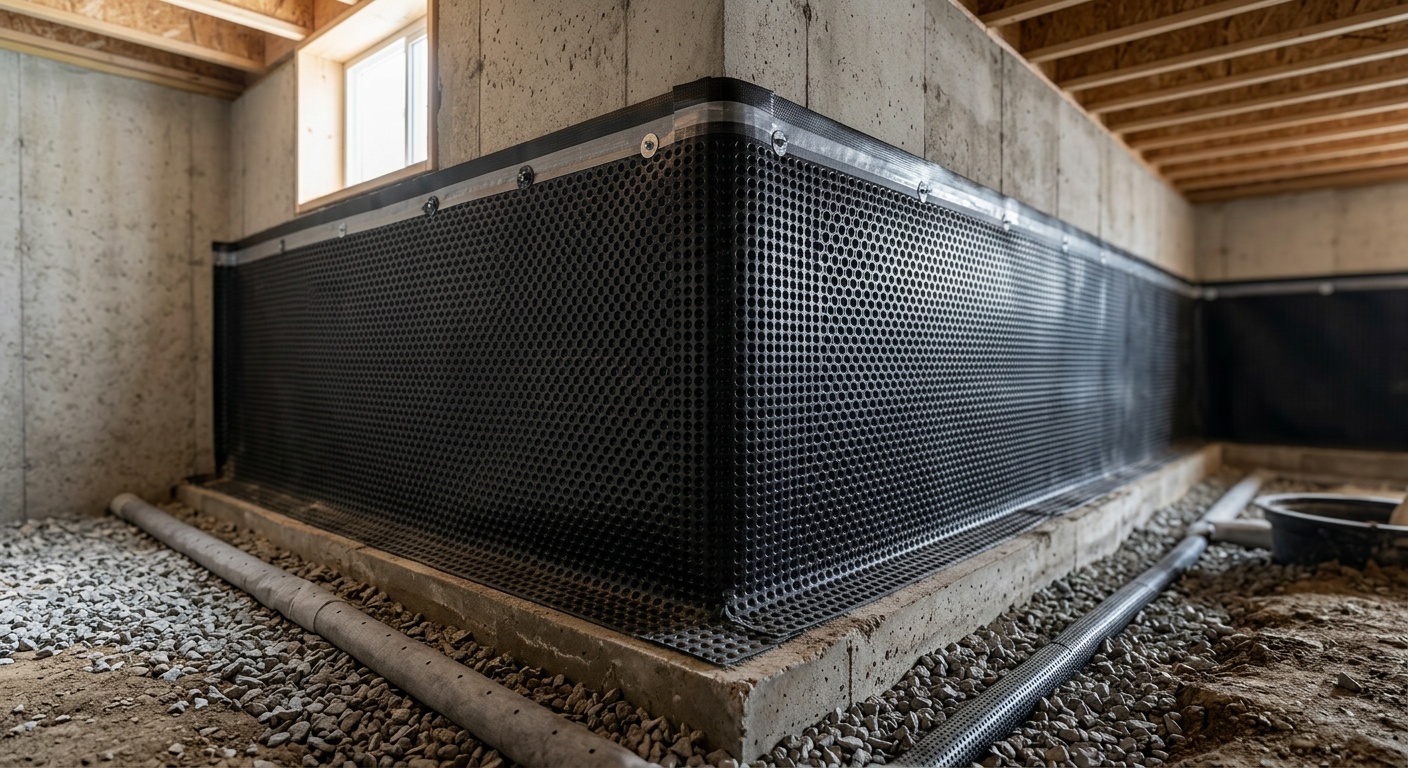
An interior drainage system — commonly called an interior weeping tile or French drain — is installed along the interior perimeter of the basement floor. A channel is cut into the concrete, a perforated pipe is laid in gravel, and water is directed to a sump pit where it’s pumped out. This method doesn’t stop water from entering the walls, but it manages water before it can accumulate on the floor. It’s particularly popular in Montreal because it’s minimally disruptive and can be installed year-round, unlike exterior excavation work.
Exterior Waterproofing Membrane
The most comprehensive solution involves excavating around the entire foundation and applying a waterproofing membrane — typically a rubberized asphalt, bentonite clay panel, or spray-applied polymer coating — directly to the exterior of the foundation wall. New exterior weeping tile is also installed at this stage. This approach addresses the problem at its source, preventing water from ever contacting the foundation, but it is also the most expensive and disruptive option. In 2026, spray-applied crystalline waterproofing membranes have gained significant traction in the Montreal market for their superior adhesion in cold-weather application conditions.
Sump Pump Systems
A sump pump is often part of any comprehensive waterproofing strategy but rarely a standalone solution. Modern battery-backup sump pump systems are essential in Montreal, where spring ice storms and power outages frequently coincide with peak water infiltration events. In 2026, Wi-Fi-enabled smart sump pumps with mobile alerts have become the standard recommendation for Montreal homeowners — they notify you immediately if the pump activates or fails, even when you’re away at the chalet.
Crystalline Waterproofing Products
Applied as a slurry or powder to interior concrete surfaces, crystalline waterproofing compounds penetrate the concrete matrix and form insoluble crystals that block capillary water movement. Products like Xypex and Krystol have strong track records in Montreal’s climate. While they work best on sound concrete, they are an excellent supplement to drainage systems and are increasingly used by Montreal contractors as a first line of defense in newer concrete foundations.
Interior vs. Exterior Waterproofing: The Real Comparison
This is the question every Montreal homeowner eventually asks, and the honest answer is: it depends on your situation. Here’s a side-by-side comparison to help you navigate the decision:
| Factor | Interior Waterproofing | Exterior Waterproofing |
|---|---|---|
| Typical Cost (2026 Montreal) | $5,000 – $15,000 | $15,000 – $45,000+ |
| Disruption Level | Moderate (interior demo) | High (full excavation) |
| Addresses Root Cause? | No — manages water after entry | Yes — prevents water entry |
| Seasonal Availability | Year-round | Spring through fall only |
| Best For | Budget-conscious, minor-moderate infiltration | Severe water problems, new construction |
The practical reality for most Montreal homeowners is that interior waterproofing — combined with crack injection and a high-quality sump pump — addresses the majority of residential moisture problems effectively. Exterior waterproofing is the gold standard but is typically reserved for severe structural situations, major renovations, or cases where interior access is impractical.
Costs and What to Expect in 2026
Let’s talk numbers — because waterproofing costs in Montreal have shifted meaningfully since 2024 due to labour shortages in the skilled trades sector and increased material costs tied to supply chain normalization. Here’s a realistic breakdown for 2026:
Understanding the Cost Spectrum
2026 Montreal Waterproofing Cost Comparison (Relative Investment)
One critical note for 2026: the Régie du bâtiment du Québec (RBQ) now requires that any waterproofing contractor working on structural elements hold a valid RBQ licence in the appropriate subcategory. Always verify your contractor’s licence on the RBQ’s online portal before signing any contract. Unlicensed work not only voids your home insurance claims but also creates significant liability if the property is sold.
Additionally, Hydro-Québec’s 2025 rate restructuring and rising labour costs have pushed excavation costs up approximately 18% compared to 2023, according to the Association des entrepreneurs en construction du Québec. Budget accordingly and get a minimum of three quotes from RBQ-licensed contractors.
DIY vs. Professional Waterproofing: Where the Line Is
Here’s the straight talk: some waterproofing tasks are genuinely DIY-friendly, while others require professional expertise and equipment. Confusing the two is one of the most expensive mistakes Montreal homeowners make.
Reasonable DIY territory includes:
- Applying hydraulic cement to active leaks in poured concrete
- Installing or maintaining a sump pump with a battery backup (basic models)
- Improving exterior grading to direct water away from the foundation
- Cleaning and extending downspouts (minimum 6 feet from foundation)
- Applying waterproofing paint (note: this is a moisture retarder, not a true waterproofer)
Leave this to the professionals:
- Polyurethane or epoxy crack injection (requires specialized equipment and pressure calibration)
- Interior drainage channel installation (involves structural concrete cutting)
- Any exterior excavation and membrane application
- Foundation assessment for structural cracks or movement
- Mold remediation alongside waterproofing (requires certified professionals under IICRC standards)
Pro Tip: Before hiring any waterproofing company, request references from projects completed in the same Montreal borough. A contractor experienced with Outremont’s fieldstone foundations may not have the right expertise for a Brossard-era poured concrete bungalow. Local experience matters enormously in this field.
Real Montreal Case Studies
Case Study 1: The Plateau Triplex Transformation
In the spring of 2025, a property owner managing a 1912 triplex on Rue Marie-Anne in Plateau-Mont-Royal contacted a Montreal waterproofing company after tenants on the ground floor reported recurring water intrusion every year following snowmelt. An inspection revealed the original rubble stone foundation had no waterproofing membrane of any kind — typical for buildings of that era — and hydrostatic pressure was pushing groundwater directly through the mortar joints.
The solution: a combination of interior drainage channel installation along the full perimeter, crystalline waterproofing slurry applied to the stone wall interior, and a new dual-pump sump system with battery backup. Total project cost: approximately $22,000. The owner reported zero water intrusion through the 2026 spring melt — the first dry spring in over a decade. Tenant satisfaction improved, and the owner avoided what an inspector estimated would have become a $60,000+ foundation repair within five years if left unaddressed.
Case Study 2: The Laval Bungalow Pre-Sale Fix
A homeowner in Laval-des-Rapides preparing to list their 1978 bungalow in early 2026 discovered during a pre-sale inspection that three poured concrete cracks in the foundation had been allowing seasonal seepage. The cracks were classic shrinkage cracks from original curing, now widened by decades of freeze-thaw cycling.
Rather than hiding the issue, the seller invested $2,400 in professional polyurethane injection for all three cracks plus an upgraded sump pump with a Wi-Fi monitoring system. The investment paid back immediately: their real estate agent reported that disclosing the completed waterproofing work — with transferable warranty documentation — actually increased buyer confidence and contributed to receiving two competing offers at asking price. A transparent, professionally documented repair is now considered a selling feature in Montreal’s 2026 real estate market.
Frequently Asked Questions
How do I know if my Montreal basement needs waterproofing or just better ventilation?
Great question — and it’s one many homeowners get wrong. If your basement humidity is consistently above 60% even in winter, and you’re not seeing wall staining, efflorescence, or actual water pooling, the problem may indeed be condensation from interior warm air hitting cold walls rather than true water infiltration. A simple test: tape a 30cm square piece of plastic sheeting to the basement wall with all four edges sealed, leave it for 48 hours, then check. If moisture forms on the room side of the plastic, it’s condensation. If moisture forms on the wall side, water is migrating through your foundation. True water infiltration requires waterproofing; condensation issues are often addressed with improved ventilation, a dehumidifier, or interior insulation.
Does the City of Montreal offer any financial assistance for basement waterproofing?
As of 2026, the Ville de Montréal’s Programme de réhabilitation des conduites de branchement offers partial reimbursements for homeowners who replace deteriorated lateral water and sewer connections as part of a foundation waterproofing project — but this applies specifically to the connection pipes, not the waterproofing membrane itself. Additionally, some boroughs have targeted programs for flood-prone areas. Check with your borough office and consult the Ville de Montréal’s website for current grant availability, as these programs are updated annually. Some Quebec homeowners’ insurance policies also offer “water infiltration prevention” credits when certified waterproofing work is completed by an RBQ-licensed contractor.
How long does basement waterproofing last in Montreal’s climate?
This depends significantly on the method used. Interior drainage systems with quality sump pumps typically carry warranties of 10 to 25 years from reputable Montreal contractors, and many last the lifetime of the home with proper maintenance. Exterior waterproofing membranes — when properly installed — are designed to last 20 to 30 years, though the quality of installation and the specific product used matter enormously. Crack injection repairs are highly durable for non-moving cracks, while cracks with ongoing movement may require re-treatment over time. The most important longevity factor in Montreal’s climate is annual maintenance: cleaning your sump pit, testing your pump before snowmelt season, clearing downspouts, and inspecting your window wells every fall.
Your Dry Basement Roadmap: Next Steps
You’ve now got a comprehensive picture of what Montreal basement waterproofing really involves — the climate factors, the warning signs, the methods, the costs, and the hard-won lessons from real homeowners. But knowledge only protects your home when it’s followed by action. Here’s your concrete next-steps roadmap:
- Conduct a baseline inspection this week. Walk through your basement with a flashlight and look for every warning sign described in this guide. Document everything with photos and note where and when you see moisture. This baseline will help any contractor diagnose the problem accurately and give you a record for insurance purposes.
- Identify your foundation type. Pull out your property deed, home inspection report, or contact the previous owner. Knowing whether you have rubble stone, concrete block, or poured concrete narrows the solution set significantly and helps you evaluate contractor proposals intelligently.
- Get three quotes from RBQ-licensed contractors. Ask each one to provide a written scope of work, the specific products they’ll use, and the warranty terms in writing. Verify their RBQ licence number at regie-bat.gouv.qc.ca before signing anything.
- Address exterior drainage issues regardless of your interior plan. Clean your gutters, extend your downspouts, re-grade any soil that slopes toward your foundation, and clear any window well drains. These free or low-cost measures reduce hydrostatic pressure on your foundation and improve the long-term performance of any waterproofing system.
- Install or upgrade your sump pump before the next snowmelt season. If your pump is more than seven years old, replace it proactively. Add a battery backup system and, in 2026, consider a Wi-Fi-enabled smart pump that sends you real-time alerts.
As Montreal’s climate continues to shift toward more intense rainfall events and unpredictable freeze-thaw cycles — a trend backed by every major Canadian climate projection through 2030 — the cost of waiting grows faster than the cost of acting. A dry, structurally sound basement isn’t just a comfort upgrade; it’s one of the highest-ROI investments you can make in your Montreal property.
Here’s the question worth sitting with: If your basement showed a visible crack today, would you know whether it was a cosmetic issue or a structural emergency? If the honest answer is no, that’s your signal to schedule a professional assessment this season — not next year, not after the next snowmelt. Your home’s foundation is its most critical system, and in Montreal’s demanding climate, proactive protection is always far less expensive than reactive repair.