Signs Your Montreal Home Needs Emergency Foundation Waterproofing
Reading time: 12 minutes
There’s a moment every Montreal homeowner dreads: you walk into your basement after a heavy April rainstorm and feel that unmistakable dampness underfoot. Maybe you spot a thin trickle running down the concrete wall, or perhaps you notice a white, chalky residue that wasn’t there last spring. Your stomach drops. Is this serious? Can it wait until next season? Or are you staring at the early warning signs of a foundation crisis?
Here’s the straight talk: Montreal’s unique climate, geology, and aging housing stock make foundation waterproofing not just a recommendation — it’s often a matter of structural survival. With freeze-thaw cycles that can exceed 80 events per winter season in the greater Montreal area, and with much of the city built on clay-heavy soil that expands when wet, your foundation faces daily battles that homes in more temperate climates simply never encounter.
This guide cuts through the confusion and helps you identify exactly when a waterproofing issue crosses from “monitor it” territory into genuine emergency status — and what to do about it fast.
Table of Contents
- Why Montreal Foundations Are Especially Vulnerable
- The Critical Warning Signs You Cannot Ignore
- Emergency vs. Routine: How to Tell the Difference
- Real Montreal Cases: Lessons From the Field
- The True Cost of Waiting
- Emergency Waterproofing Solutions Available in 2026
- Frequently Asked Questions
- Your Foundation Protection Roadmap
Why Montreal Foundations Are Especially Vulnerable
Before diving into specific warning signs, it’s worth understanding why Montreal homes face disproportionate foundation stress compared to other North American cities. Context shapes urgency — and in this case, the context is genuinely sobering.
The Perfect Storm of Climate and Geology
Montreal sits in a geological zone characterized by Leda clay, also known as quick clay or marine clay, which was deposited when the Champlain Sea covered the region thousands of years ago. This soil type is notorious for its instability when saturated with water. Unlike sandy or loamy soils that drain relatively efficiently, Leda clay holds water against your foundation walls for extended periods — essentially pressing moisture into every crack and pore in your concrete or stone.
Layer on top of that Montreal’s brutal winter-spring transition. In 2025, Environment Canada recorded 94 freeze-thaw cycles in the Montreal metropolitan area between November and April — a number that’s become increasingly common as climate patterns shift. Each freeze-thaw event causes water trapped in foundation cracks to expand by approximately 9% in volume, physically forcing those cracks wider. By the time spring arrives, what was a hairline crack in October may be a structural fissure in April.
Additionally, Montreal’s aging housing stock compounds the risk. According to the City of Montreal’s 2026 housing registry, approximately 43% of residential properties in the city were built before 1970, when waterproofing standards were dramatically lower or nonexistent. Many of these homes rely on tar-based dampproofing — not true waterproofing — which degrades over decades and becomes brittle and ineffective.
The Urban Drainage Challenge
Montreal’s combined sewer system — which handles both stormwater and sewage through the same pipes — creates an additional complication. During heavy rainfall events, which have increased in frequency since 2022, these systems can become overwhelmed. When that happens, hydrostatic pressure builds up in the soil surrounding thousands of residential foundations simultaneously. In 2025, the City of Montreal received over 6,200 insurance claims related to basement flooding, the third-highest annual figure on record.
This isn’t a problem that’s getting better on its own. It’s a systemic challenge that individual homeowners must actively address.
The Critical Warning Signs You Cannot Ignore
Let’s get specific. Not every damp spot is an emergency, but certain signs demand immediate professional attention. Here’s how to read your foundation like a trained inspector.
Structural Red Flags: When Your Foundation Is Telling You It’s Failing
1. Horizontal Cracks in Block or Poured Concrete Walls
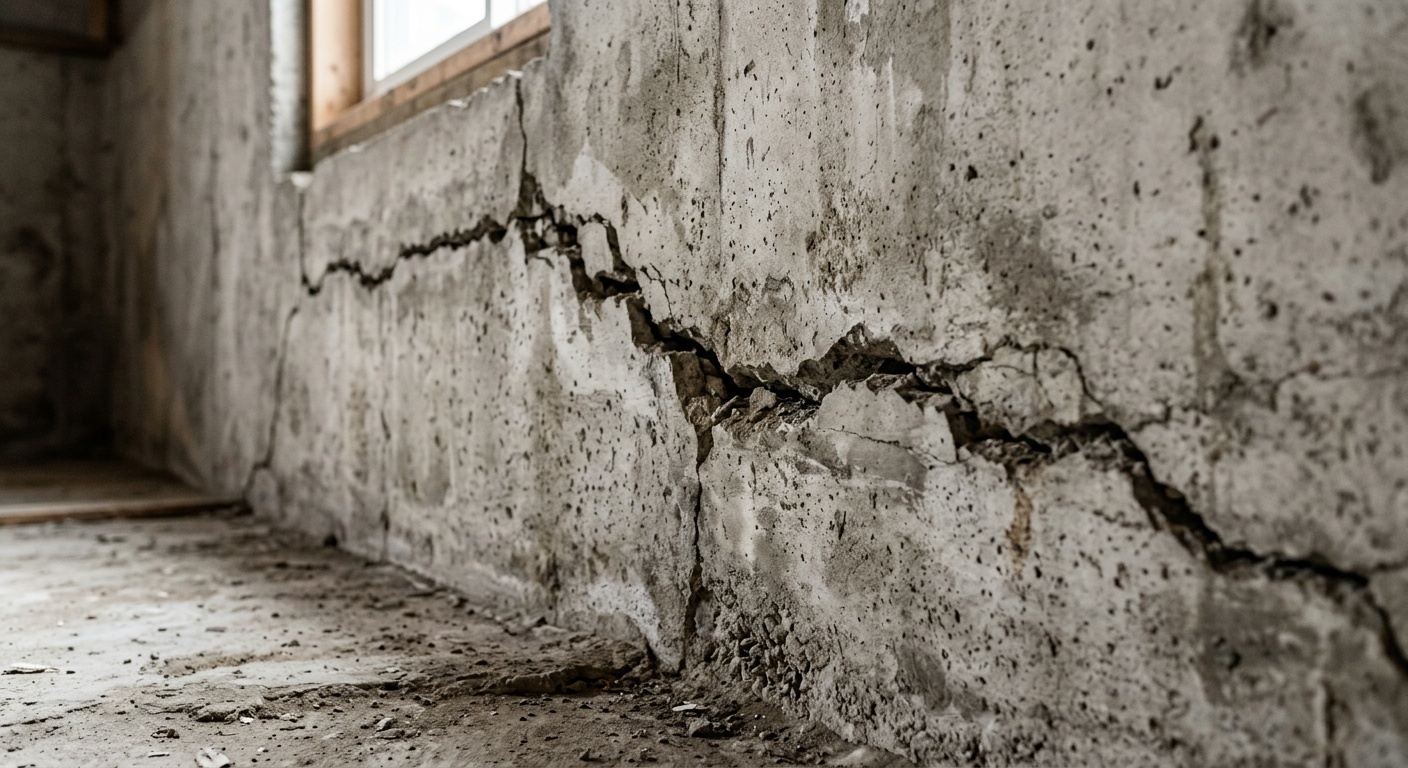
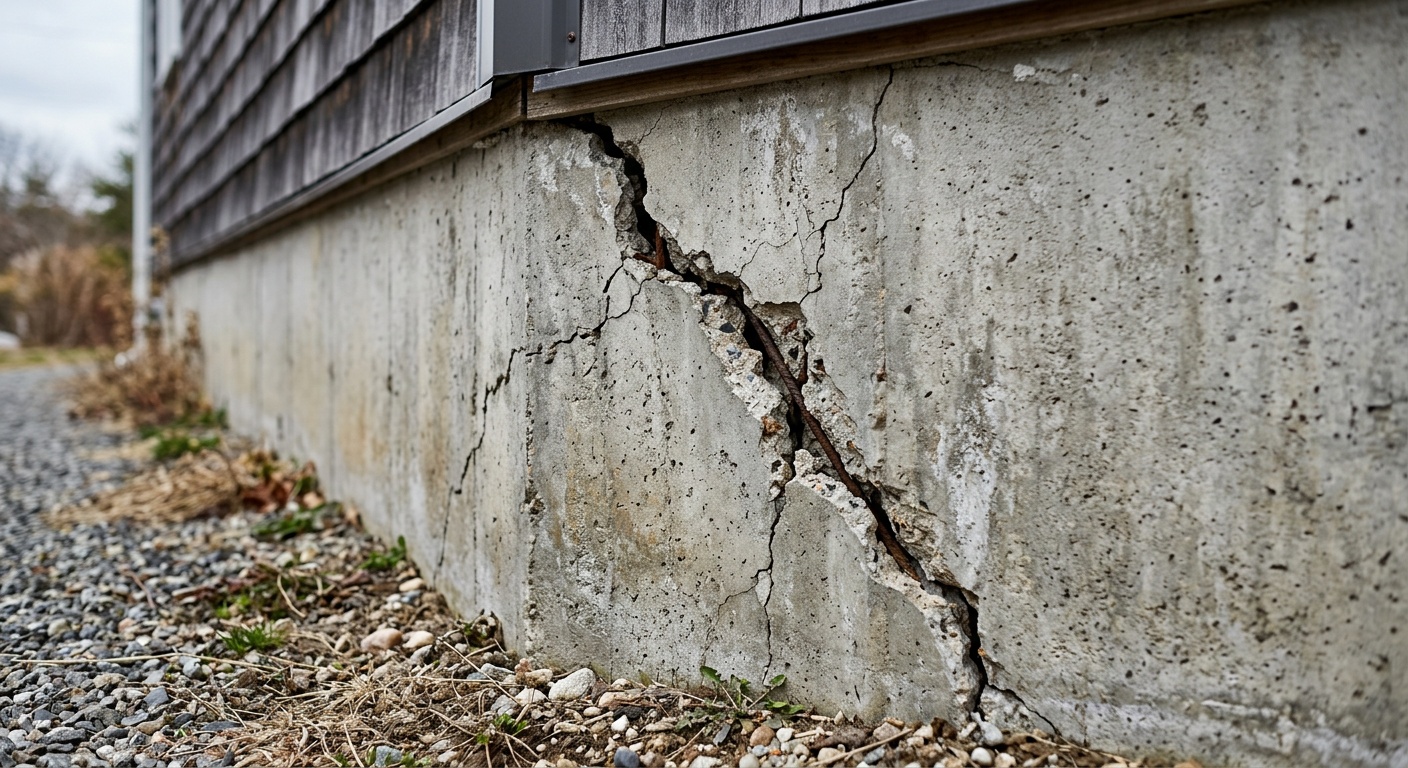
This is perhaps the single most alarming sign a homeowner can encounter. While vertical cracks often result from normal settlement and can frequently be repaired with injectable sealants, horizontal cracks indicate that lateral soil pressure is actively bending or shearing your foundation wall. In Montreal’s clay-heavy soils, this kind of pressure builds silently over years and then manifests suddenly. A horizontal crack wider than 3mm, or one that runs continuously across more than 60% of a wall, should be treated as a structural emergency requiring same-week professional evaluation.
2. Stair-Step Cracks in Mortar Joints
If your foundation is built from concrete block or brick, watch for diagonal stair-step cracks running along mortar joints. These indicate differential settlement — meaning one section of your foundation is sinking at a different rate than another. When combined with water infiltration, differential settlement accelerates rapidly, as saturated soil loses its load-bearing capacity.
3. Wall Bowing or Inward Deflection
Stand at one end of your foundation wall and look along its surface. Any visible bowing, even subtle curves of 2-3 cm, signals that soil pressure is winning the battle against your structural walls. Foundation engineers in Montreal consistently flag wall deflection greater than 1 inch (2.5 cm) as requiring immediate intervention. Beyond that threshold, the cost and complexity of repair escalates dramatically.
4. Active Water Intrusion During Rain Events
There’s a critical distinction between residual dampness and active water intrusion. If you can observe water flowing, seeping, or streaming into your basement during or immediately after rainfall, this is an emergency — not a seasonal nuisance. Active intrusion indicates that your drainage systems (whether interior or exterior) have failed completely, and the water volume entering your space will increase with every subsequent rain event.
5. White Efflorescence Combined With Flaking Concrete
Efflorescence — those white, powdery mineral deposits on your basement walls — is caused by water moving through concrete and depositing dissolved salts on the surface. Alone, efflorescence is a warning sign. Combined with spalling (flaking or crumbling concrete surface), it indicates that freeze-thaw damage has penetrated deep into your wall’s structure, compromising its integrity. At this stage, surface treatments are ineffective; you need comprehensive waterproofing intervention.
6. Mold Growth on Walls or Floor Joists
Visible mold on your foundation walls or, critically, on the underside of your floor joists above the basement, is a health emergency and a structural warning simultaneously. Quebec’s building code considers any visible mold growth in habitable spaces a violation requiring remediation. More importantly, mold on floor joists indicates that moisture levels have been consistently elevated long enough to threaten the wood structural components supporting your home’s main floor.
7. Doors and Windows That Suddenly Stick or No Longer Close Properly
This one surprises many homeowners. When foundation movement or settlement occurs, the door and window frames above shift out of square. If multiple doors or windows in your home have recently become difficult to open or close — particularly on the ground floor — this could indicate foundation movement directly related to water-related soil instability beneath your home.
Emergency vs. Routine: How to Tell the Difference
Not every waterproofing issue demands a contractor on your doorstep by Monday morning. But some absolutely do. Here’s a practical framework for categorizing what you’re dealing with.
| Symptom | Severity Level | Timeline to Act | Typical Cost Range (2026 CAD) |
|---|---|---|---|
| Horizontal wall crack (>3mm wide) | EMERGENCY | Within 48–72 hours | $8,000 – $25,000+ |
| Active water flow during rain | EMERGENCY | Same day / 24 hours | $5,000 – $18,000 |
| Visible wall bowing (>1 inch) | EMERGENCY | Within 72 hours | $12,000 – $40,000 |
| Efflorescence without spalling | Moderate | Within 2–4 weeks | $2,500 – $9,000 |
| Minor seasonal dampness, no cracks | Routine | Next dry season | $1,500 – $5,000 |
Note: Cost ranges reflect 2026 Montreal market rates. Prices vary significantly based on property size, access complexity, and whether interior or exterior waterproofing is required.
Real Montreal Cases: Lessons From the Field
Abstract advice only goes so far. Let’s look at two real-world scenarios that illustrate how quickly foundation situations can escalate — and what decisive action looked like in each case.
Case Study 1: The Verdun Duplex That Almost Didn’t Make It
In March 2025, the owners of a 1952-era duplex in Verdun noticed water seeping through a hairline crack along the base of their north-facing foundation wall after an unusual mid-March thaw. The crack had been visible for two winters but seemed stable. After the spring thaw of 2025, however, the crack widened to nearly 8mm and developed a horizontal component running approximately 1.8 meters across the wall.
A foundation specialist was called in and immediately identified active wall deflection — the wall had bowed inward by approximately 4 cm due to the expansive pressure of saturated Leda clay. The diagnosis: the wall was at genuine risk of collapse under the next significant hydrostatic pressure event. Emergency carbon fiber strapping was installed within 72 hours to stabilize the wall, followed by exterior excavation and full membrane waterproofing the following month. Total cost: approximately $34,000. Had the owners waited another season, structural engineers estimated the wall repair alone would have exceeded $80,000 — potentially requiring full foundation replacement on that elevation.
Key lesson: A crack that “seems stable” in a Montreal winter may not be stable at all — it may simply be frozen in place. The real test comes at spring thaw.
Case Study 2: The Plateau Home With Hidden Mold
A homeowner in the Plateau-Mont-Royal neighborhood purchased a 1965 triplex in early 2025 after a standard home inspection. The inspector noted “minor moisture evidence” in the basement but flagged no emergency concerns. By summer 2025, the new owner noticed a persistent musty odor that air fresheners couldn’t mask.
A specialized moisture assessment revealed that mold had colonized approximately 40% of the floor joist surfaces above the basement, fed by chronic moisture infiltration through the poured concrete floor — a common issue in homes of that era where floor drainage membranes were never installed. The remediation required mold abatement, floor joist treatment, installation of an interior drainage system with a sump pump, and dehumidification infrastructure. Total cost: $22,500. The homeowner’s insurance covered a portion, but only after extensive negotiation, as the damage was deemed pre-existing.
Key lesson: Standard home inspections frequently miss moisture infiltration issues that aren’t visually obvious at the time of inspection. If you’re purchasing an older Montreal home, commission a specialized moisture and foundation assessment separately.
The True Cost of Waiting
One of the most common questions Montreal homeowners ask is: “Can I deal with this next year?” The honest answer is: sometimes yes, usually no, and occasionally absolutely not.
Foundation waterproofing problems follow what engineers call an exponential damage curve. In the early stages, intervention is relatively straightforward and affordable. As water infiltration continues, it triggers cascading damage — to insulation, framing, electrical systems, and the foundation structure itself — and costs multiply rapidly.
Here’s a data visualization of how repair costs typically escalate by stage of intervention delay in Montreal’s climate:
Foundation Repair Cost Escalation by Delay Period (Montreal, 2026 CAD)
*Bar widths represent relative cost proportion. Percentages shown for proportional comparison. Source: Association des professionnels de la construction et de l’habitation du Québec (APCHQ), 2025–2026 data.
Beyond direct repair costs, consider the cascading financial impacts: reduced property value (Montreal real estate agents report that disclosed foundation issues can reduce sale prices by 8–15%), potential insurance complications, and the personal cost of living through an emergency repair that could have been a planned renovation.
Emergency Waterproofing Solutions Available in 2026
If you’ve identified one or more warning signs in your home, understanding your options — and their realistic timelines — is the next critical step.
Interior Waterproofing Systems
Interior drainage systems (often called interior weeping tile or French drain systems) are installed along the interior perimeter of your basement floor. They capture water that enters the foundation and redirect it to a sump pump for expulsion. This approach doesn’t stop water from entering the wall, but it manages it effectively before it causes damage. Interior systems can typically be installed in 2–5 days, making them the fastest solution for active water emergencies.
Modern interior systems installed in 2026 often incorporate smart sump pump technology, with Wi-Fi connected monitoring that alerts homeowners via smartphone when water levels rise abnormally — a significant upgrade from even five years ago. Leading Montreal waterproofing contractors now include these systems as standard with interior installations.
Exterior Waterproofing: The Gold Standard
Exterior waterproofing involves excavating the soil around your foundation, thoroughly cleaning the walls, applying a waterproof membrane (modern systems use polymer-modified asphalt or crystalline waterproofing compounds), installing new drainage board and weeping tile, and carefully backfilling with clean, draining gravel. This approach addresses water before it ever contacts your foundation wall — the only true solution for severe infiltration.
The limitation is logistics: exterior waterproofing requires significant excavation, typically takes 5–14 days to complete (weather permitting), and is considerably more expensive than interior approaches. However, for homes with structural wall damage or severe infiltration, it’s often the only viable long-term solution.
Carbon fiber wall stabilization is frequently used in conjunction with exterior waterproofing when wall bowing or cracking has occurred. Carbon fiber straps are bonded to the wall surface and anchored to the floor and ceiling structure, halting further deflection. This system is remarkably fast to install (usually one day) and adds substantial structural rigidity without excavation.
Crystalline waterproofing injection — a technology that has advanced significantly through 2024 and 2025 — involves injecting a cementitious crystalline compound directly into cracks and pores in concrete. The crystals grow in the presence of water, self-sealing future cracks as well as existing ones. This approach is used primarily for poured concrete foundations and offers excellent long-term durability.
Frequently Asked Questions
How quickly do I need to act if I see water actively coming through my basement wall?
Treat active water intrusion as an emergency requiring same-day or next-day professional contact. While you wait, use a wet/dry vacuum to remove standing water and position fans to improve air circulation — but do not attempt to seal an actively leaking crack with DIY products, as hydrostatic pressure can cause these products to fail rapidly and mask the true extent of the problem. Contact a licensed foundation waterproofing contractor in Montreal immediately; most reputable firms offer emergency response services within 24 hours. The longer active water infiltration continues, the greater the risk of mold growth (which can begin within 24–48 hours in favorable conditions) and structural saturation.
Will my home insurance cover foundation waterproofing in Montreal?
Generally, standard Quebec home insurance policies do not cover the cost of waterproofing itself, which is considered a maintenance issue. However, many policies do cover damage caused by sudden water infiltration events — such as damaged flooring, drywall, and personal property — if you can demonstrate the event was sudden and accidental rather than the result of gradual neglect. In 2025, several major Quebec insurers introduced optional sewer backup and overland flooding endorsements that provide broader coverage. Review your policy carefully and document all water intrusion events with photographs and dated reports. Importantly, if you’re aware of a foundation problem and don’t address it, insurers may deny future claims related to that condition on grounds of negligence.
What’s the difference between dampproofing and waterproofing, and does my older Montreal home have either?
This distinction is critically important for Montreal homeowners with older properties. Dampproofing — typically a thin tar or bitumen coating applied to foundation walls during original construction — is designed to resist soil moisture only. It is not a waterproofing system and will not withstand hydrostatic pressure (water under pressure pushing against your foundation). Virtually all Montreal homes built before 1975 used dampproofing only, and that coating has almost certainly degraded significantly over the decades. Waterproofing, by contrast, involves membrane systems, drainage layers, and integrated water management that can withstand sustained hydrostatic pressure. If your home predates 1980 and has never had foundation work done, assume you have degraded dampproofing at best — and plan your inspection and waterproofing upgrade timeline accordingly.
Protecting Your Foundation: An Action Roadmap for Montreal Homeowners
You’ve absorbed a lot of information. Now let’s make it actionable. Here’s your practical, step-by-step roadmap for addressing foundation waterproofing — whether you’re in crisis mode or planning proactively.
Step 1: Conduct an honest self-assessment this week. Walk through your basement with a flashlight and look specifically for every warning sign described in this article. Document everything with your smartphone camera. Pay special attention to wall cracks (direction, width, location), signs of water staining, efflorescence, and any visible mold or musty odors. Don’t rationalize away things that concern you.
Step 2: Categorize your situation using the emergency framework. If you identified horizontal cracks, active water flow, or visible wall bowing — stop. You’re in emergency territory. Call a licensed contractor today. If your findings were less alarming, schedule a professional assessment within the next two to four weeks. Do not wait until next spring; problem identification in fall gives you winter planning time.
Step 3: Get multiple quotes — but vet contractors carefully. In Quebec, foundation contractors must hold an appropriate license with the Régie du bâtiment du Québec (RBQ). Verify any contractor’s license on the RBQ website before signing anything. Get a minimum of three written quotes, and be suspicious of quotes that are dramatically lower than others — foundation work is rarely cheap when done correctly, and shortcuts create expensive failures.
Step 4: Understand your financing options before you need them. As of 2026, the Canadian Mortgage and Housing Corporation (CMHC) offers the MLI Select program, which can incorporate renovation financing for qualifying homeowners. The City of Montreal also periodically offers subsidized loan programs for sewer and water management upgrades — check montreal.ca for current offerings, as these programs open and close based on available funding.
Step 5: After remediation, implement ongoing monitoring. Install a quality basement humidity monitor (smart models connect to your phone) and schedule annual inspections of your foundation, particularly after the spring thaw each year. Most major waterproofing issues that become emergencies began as minor, detectable problems that were never caught early.
As Montreal continues to face increasingly intense precipitation events driven by shifting climate patterns — a trend that Environment Canada projects will accelerate through 2030 — foundation waterproofing is transitioning from a discretionary upgrade to a fundamental aspect of responsible homeownership in this city. Your home’s foundation is exactly what the name implies: the foundation of everything else. Protect it with the urgency it deserves.
So here’s the question worth sitting with: If your foundation showed its first stress signal today, would you know what you were looking at — and would you know exactly who to call?