Interior vs Exterior Waterproofing: Which Is Right for Montreal?
Reading time: 14 minutes
Montreal homeowners know the drill: the moment spring arrives and that iconic snowpack starts melting, basements across the island begin telling their own watery stories. Whether it’s a slow trickle along the foundation wall or a full-on flood event after a heavy April downpour, water intrusion is one of the most persistent — and costly — challenges facing property owners in this city.
But here’s where it gets complicated: not all waterproofing is created equal, and choosing the wrong approach for your specific situation can mean thousands of dollars wasted and a wet basement in year two. The debate between interior waterproofing and exterior waterproofing isn’t just technical — it’s deeply personal, budget-driven, and tied directly to Montreal’s unique climate, soil conditions, and housing stock.
Let’s cut through the noise and give you a real-world, Montreal-specific breakdown of both approaches so you can make a confident, informed decision.
Table of Contents
- Understanding Montreal’s Water Problem
- Exterior Waterproofing: The Gold Standard
- Interior Waterproofing: The Practical Alternative
- Head-to-Head Comparison
- Cost vs. Effectiveness at a Glance
- Real Montreal Scenarios
- 3 Common Challenges and How to Overcome Them
- Frequently Asked Questions
- Your Waterproofing Roadmap: Next Steps
Understanding Montreal’s Water Problem
Before diving into solutions, it’s worth understanding why Montreal is particularly vulnerable to basement water issues. The city sits on an island at the confluence of the St. Lawrence and Ottawa rivers, built on a mix of limestone bedrock, clay-heavy soils, and glacial till. That combination creates a drainage challenge that affects tens of thousands of homes every single year.
In 2025, the City of Montreal recorded over 4,200 basement flooding claims through its municipal insurance assistance program — a 17% increase over the previous year, largely attributed to two major freeze-thaw cycles and an unusually wet October. According to data published by the Institut national de la recherche scientifique (INRS) in early 2026, climate projections suggest that intense precipitation events in the Greater Montreal Area will increase by approximately 22% over the next two decades.
Translation? Your basement water problem isn’t going away on its own. And the approach you choose today will determine how your home weathers the next 20 years of Montreal winters and springs.
Why Montreal Homes Are Especially Vulnerable
A significant portion of Montreal’s housing stock was built between 1920 and 1970. Many of these homes feature stone or brick foundations with original tar-based waterproofing membranes that have long since deteriorated. Add to this the city’s infamous freeze-thaw cycles — Montreal experiences an average of 65 to 80 freeze-thaw events per winter season — and you have a recipe for foundation stress, cracking, and water infiltration.
The city’s combined sewer system (carrying both stormwater and sewage) also comes under enormous pressure during heavy rain events, causing backflow issues that compound the problem. Whether you’re in Rosemont, Verdun, NDG, or Pointe-Claire, the underlying vulnerability is remarkably consistent.
The Two Fundamental Approaches
Waterproofing professionals generally draw a clear line between two philosophies:
- Exterior waterproofing: Stop water before it ever reaches your foundation walls
- Interior waterproofing: Manage water after it has entered the foundation zone, redirecting it before it causes damage
Neither approach is universally superior — but one will almost certainly be more appropriate for your home, your budget, and your situation. Let’s examine each in detail.
Exterior Waterproofing: The Gold Standard
If you want to prevent water from ever touching the interior of your foundation, exterior waterproofing is the most comprehensive solution available. It’s also the most invasive and expensive — but when done correctly, it’s genuinely the last waterproofing solution you’ll ever need for that property.
What Exterior Waterproofing Actually Involves
The process begins with excavation. A contractor digs down to the full depth of your foundation — often 6 to 10 feet in Montreal’s older homes — exposing the exterior walls entirely around the perimeter. Once exposed, the crew:
- Cleans the foundation wall surface thoroughly
- Repairs any visible cracks, mortar gaps, or structural deficiencies
- Applies a waterproofing membrane (typically a rubberized asphalt or polymer-based product)
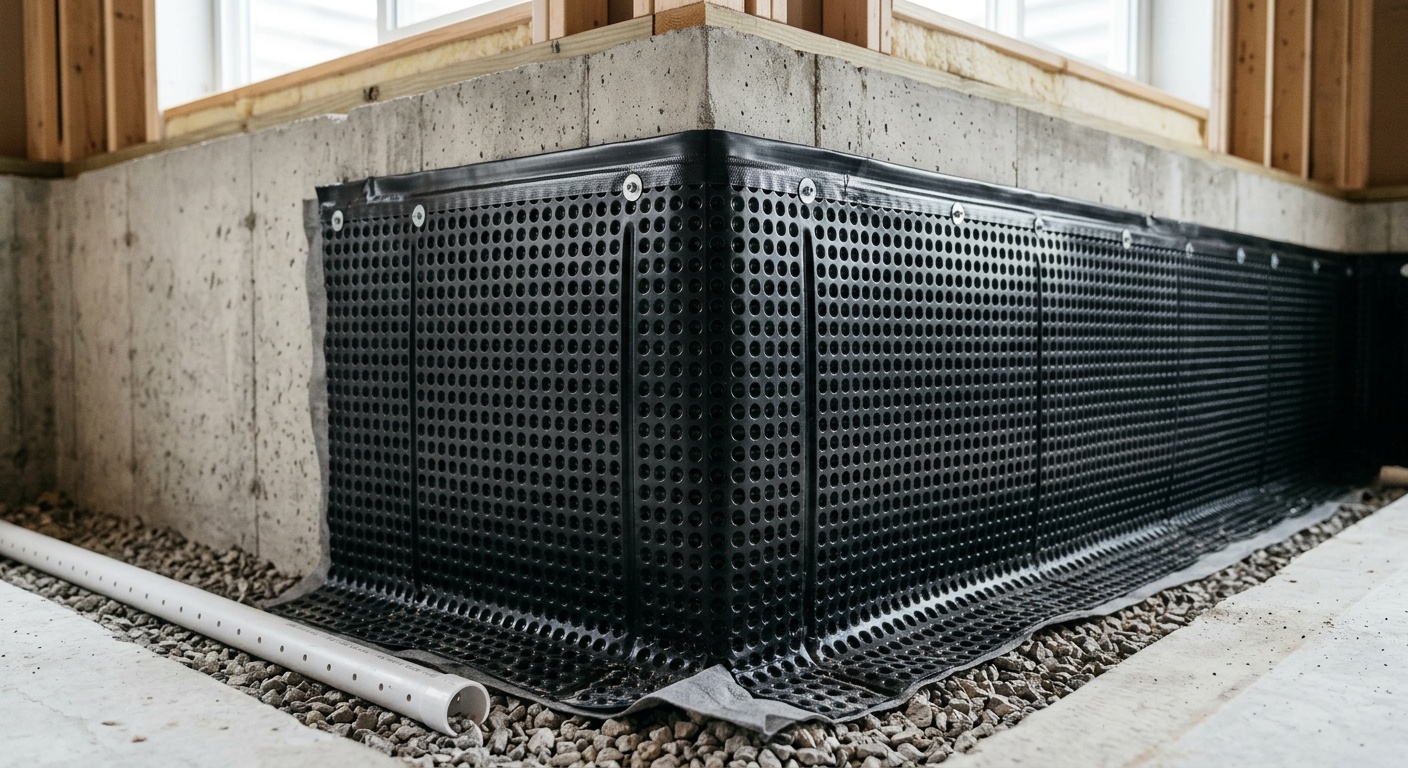
- Installs a dimple board drainage mat over the membrane to channel water downward
- Lays a perimeter drainage pipe (weeping tile) at the base of the footing
- Backfills with clear stone and appropriate soil
In Montreal, leading contractors have begun incorporating crystalline waterproofing compounds as an additional layer — these products actually grow into concrete cracks over time, self-sealing minor fissures that develop years later. It’s a significant upgrade that justifies its cost for century homes in Outremont or the Plateau.
Costs and Timeline in 2026
Exterior waterproofing in Montreal currently runs between $15,000 and $45,000 for a typical semi-detached or detached home, depending on linear footage, accessibility, depth of excavation, and soil conditions. Homes with extensive landscaping, fencing, or decking attached to the foundation add significant complexity. The process typically takes 5 to 10 working days from start to finish.
One critical consideration unique to Montreal: underground utilities. Hydro-Québec, Bell, and Énergir all require notification before excavation, and permits from the borough are mandatory. Budget an additional 2 to 3 weeks for approvals in most Montreal boroughs as of 2026.
When Exterior Waterproofing Is the Right Call
- You have an active crack in the foundation wall that is structurally significant
- The exterior drainage slope directs water toward the house rather than away
- Your home’s original waterproofing membrane has completely failed
- You’re planning a long-term stay (10+ years) and want the most permanent solution
- The basement is finished or you plan to finish it at a high level
- You have budget flexibility and want maximum property value protection
Interior Waterproofing: The Practical Alternative
Interior waterproofing has earned a somewhat unfair reputation as a “band-aid” solution — but that’s a significant oversimplification. Done properly, modern interior waterproofing systems are engineered, durable, and highly effective at protecting finished living spaces. They simply operate on a different principle: management rather than prevention.
How Interior Systems Work
The most common interior waterproofing system is an interior drain tile system, sometimes called a French drain or weeping tile system, installed beneath your basement floor. Here’s the process:
- A narrow trench (typically 12 to 18 inches wide) is cut along the interior perimeter of the basement floor
- A perforated pipe is laid in the trench, surrounded by gravel
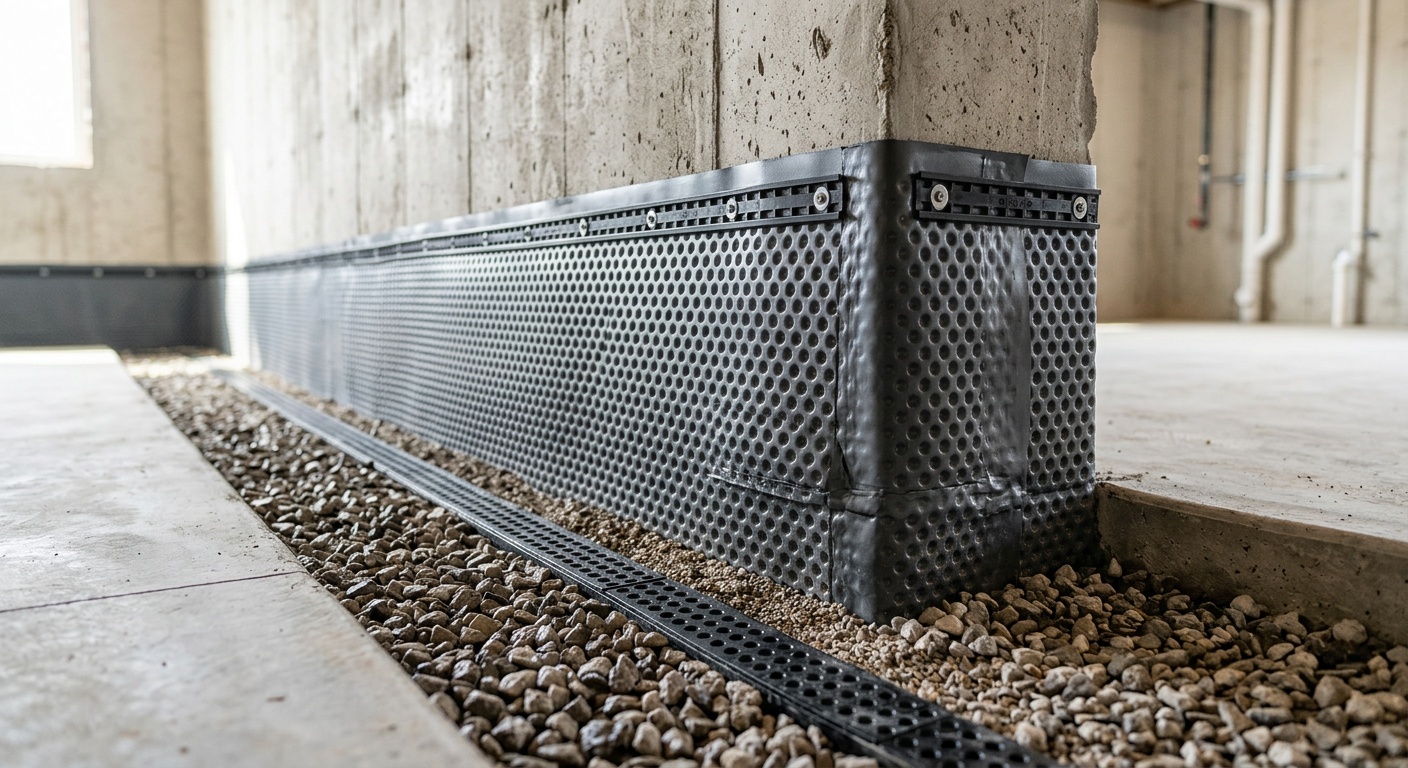
- The pipe channels any water that enters through the walls or floor toward a sump pit
- A sump pump (and typically a battery backup pump) evacuates the water outside and away from the foundation
- The trench is covered with new concrete, leaving a virtually invisible finished result
Modern interior systems also incorporate wall membrane panels — plastic sheeting anchored to the lower foundation wall that directs seeping water downward into the drainage channel rather than letting it pool on the floor or infiltrate wall insulation.
The Cost Reality in 2026
Interior waterproofing is significantly more accessible from a budget standpoint. A typical Montreal basement installation runs between $5,000 and $15,000, depending on basement size, number of sump pits required, and whether wall panels are included. The work is typically completed in 1 to 3 days with minimal disruption to landscaping, decks, or outdoor structures.
Because no excavation is required, there are no permit delays for exterior digging — though any structural modifications still require appropriate documentation. Many Montreal contractors can begin interior work within days of signing a contract, making it the preferred emergency response option after a flooding event.
When Interior Waterproofing Makes the Most Sense
- Your home is semi-detached or row housing with minimal side yard access for excavation
- Budget constraints make exterior waterproofing currently unfeasible
- The water infiltration is diffuse (seeping through multiple points) rather than a single crack
- You need a fast solution — spring thaw is two weeks away
- Landscaping, mature trees, or permanent structures make exterior excavation impractical
- The foundation is structurally sound but the waterproofing membrane has simply aged out
Head-to-Head Comparison
| Metric | Exterior Waterproofing | Interior Waterproofing |
|---|---|---|
| Average Cost (Montreal, 2026) | $15,000 – $45,000 | $5,000 – $15,000 |
| Installation Time | 5–10 working days + permit wait | 1–3 days |
| Disruption Level | High (full excavation, landscape impact) | Low to Moderate (interior only) |
| Expected Lifespan | 25–50+ years | 15–25 years (pump maintenance required) |
| Addresses Root Cause | Yes — stops water at source | Partially — manages water after entry |
Cost vs. Effectiveness at a Glance
How do the two approaches stack up across the metrics that matter most to Montreal homeowners? This visualization compares key performance indicators on a 100-point scale, weighting factors relevant to this specific market:
Long-Term Effectiveness
Budget Accessibility
Installation Speed
Property Value Impact
Suitability for Triplex/Row Housing
Scores reflect Montreal-specific conditions in 2026 (housing type, climate, permit environment)
Real Montreal Scenarios
Scenario 1: The Rosemont Duplex Owner
Marie-Ève owns a 1948 duplex on Bélanger Street — a classic Montreal plex with a stone foundation, an unfinished basement used for storage, and absolutely zero side yard access. In spring 2025, she noticed water pooling along the northeast corner of the basement after every significant rainfall. The source: a hairline crack in the stone mortar where two foundation sections met, exacerbated by decades of freeze-thaw expansion.
Exterior waterproofing was simply not viable. The property shares a party wall on one side and sits flush with the sidewalk on the other. Three reputable contractors confirmed this, and one quoted $38,000 just for the partial accessible section — with no guarantee of addressing the problem wall.
The solution: An interior drain tile system with a primary sump pump, battery backup, and full perimeter wall membrane panels. Total cost: $9,200. Installation: 2 days. As of spring 2026, the basement has remained completely dry through two thaw cycles and a record May rainfall event that flooded three neighbouring properties.
Marie-Ève’s take: “I was skeptical about interior waterproofing at first. I thought I needed to fix the wall itself. But the contractor explained that the crack was stable — it just needed to be managed, not structurally repaired. The system works. I sleep better in April now.”
Scenario 2: The Pointe-Claire Bungalow Renovation
The Lavoie family purchased a 1960s bungalow in Pointe-Claire in late 2024 with full plans to renovate the basement into a finished family room. Their home inspector flagged obvious signs of historic water damage — efflorescence staining across the entire south wall, and a failed tar membrane visible through a small excavation test pit in the backyard.
In this case, the decision was clear: the home had a large, accessible backyard, a structural foundation issue (one visible horizontal crack indicating soil pressure), and a planned finished renovation that would require a warranty-level solution. Exterior waterproofing made absolute sense.
The solution: Full exterior excavation on three sides (the fourth being accessible interior-only due to the attached garage), a rubberized membrane, dimple board, new footing drains, and grading correction. Total cost: $28,500. Work began in April 2025. The basement renovation was completed in fall 2025, and the family room debuted before Christmas — bone dry and with a transferable 25-year warranty.
Pro Tip: The Lavoies negotiated a transferable warranty into their contractor agreement specifically because they planned to sell within 10 years. That warranty added measurable value to their listing — their real estate agent confirmed buyers frequently ask about waterproofing documentation during inspections.
Scenario 3: The Emergency Call in NDG
A homeowner in Notre-Dame-de-Grâce contacted a waterproofing company on a Thursday in March 2026 after discovering standing water in their basement following an overnight ice dam event. They were hosting a family event the following weekend. Exterior work was impossible on that timeline, and frankly, the source was a single window well drain that had become completely blocked with ice and debris.
The immediate fix: Interior drain mat installation along the affected wall, sump pump upgrade, and window well drain clearing — completed Friday. A full assessment for exterior work was scheduled for May once the ground thawed fully. Sometimes the smartest move is a strategic interim solution that protects you now while you plan the permanent fix.
3 Common Challenges and How to Overcome Them
Challenge 1: Choosing a Contractor in a Saturated Market
Montreal’s waterproofing market has become increasingly crowded since 2023, fueled by rising flood insurance claims and aggressive municipal messaging about basement protection. Not every contractor offering “waterproofing” is a specialist — many are general contractors who have added the service as an upsell.
How to overcome it: Look specifically for contractors who are members of the Association des maîtres couvreurs du Québec or who hold RBQ licenses in foundation-related categories. Ask for references from projects completed at least three years ago (to verify longevity, not just initial quality). Request a written diagnostic report before any work begins — reputable waterproofing specialists will perform a moisture assessment, not just a sales walk-through.
Challenge 2: Misdiagnosing the Water Source
One of the most expensive mistakes Montreal homeowners make is treating the wrong problem. Water appearing inside a basement can originate from three very different sources: lateral pressure (groundwater pushing through walls), surface infiltration (rainwater or snowmelt running along the surface to the foundation), or condensation (warm humid air meeting cool foundation surfaces). Each requires a different response.
How to overcome it: Before signing any contract, perform the “tape test.” Tape a piece of clear plastic sheeting to the wet foundation wall, sealing all four edges completely. Check it after 48 hours. If moisture appears on the wall side of the plastic, water is coming through the wall from outside. If moisture appears on the room side, you have a condensation problem — and no waterproofing system will solve it. Condensation issues require air sealing and dehumidification, not drainage.
Challenge 3: Navigating Insurance and Municipal Programs
Many Montreal homeowners don’t realize that the Programme d’aide à la prévention des inondations offers financial assistance for waterproofing-related improvements, including backwater valve installation, sump pump subsidies, and in some boroughs, partial grants for drain tile systems. In 2026, the City of Montreal updated the eligibility criteria to include homes in expanded flood-risk zones identified by new Quebec provincial mapping.
How to overcome it: Before committing to any solution, contact your borough’s urban planning office and your home insurer. Some insurance policies now offer premium discounts for documented waterproofing upgrades. The Canadian Mortgage and Housing Corporation (CMHC) also published updated guidance in January 2026 for homeowners in high-risk zones regarding financing options for waterproofing improvements through refinancing instruments.
Frequently Asked Questions
Can I combine interior and exterior waterproofing on the same property?
Absolutely — and in some cases, it’s actually the recommended approach. For Montreal homes where one section of the foundation is accessible from outside (say, a backyard wall) while another runs beneath a shared driveway or attached structure, a hybrid solution makes excellent sense. Exterior waterproofing on accessible sections stops water at the source, while an interior drain tile system captures anything that migrates through the inaccessible sections. Many reputable contractors in Montreal offer combined solutions with integrated drainage that handles both systems through a single sump pit.
How do I know if my sump pump is adequate for Montreal’s spring thaw conditions?
This is a critical question that most homeowners don’t ask until it’s too late. A standard 1/3 horsepower sump pump is often insufficient during Montreal’s peak thaw conditions, when groundwater tables can rise dramatically within 48 hours. For most Montreal basements, a 3/4 to 1 horsepower primary pump combined with a battery-powered backup rated for at least 2,000 gallons per hour is the appropriate specification. The battery backup is non-negotiable — the highest-risk periods (heavy rain, ice storms) are precisely when power outages are most likely. Have your pump’s output tested annually before March; most waterproofing companies offer this service for under $150.
Does exterior waterproofing actually increase my home’s resale value in the Montreal market?
Yes, measurably. Based on real estate transaction data analyzed by the Chambre immobilière du Grand Montréal in late 2025, homes with documented exterior waterproofing and transferable warranties sold for an average of 2.1% to 3.8% more than comparable properties without such documentation, and spent approximately 11 fewer days on the market. The effect is most pronounced in the $600,000 to $900,000 price band — which represents a large share of the Montreal single-family home market in 2026. Importantly, you must retain all contractor documentation, warranties, and permits. Verbal assurances of past waterproofing work have essentially no value to buyers or their inspectors.
Your Waterproofing Roadmap: Making the Right Call for Your Home
Here’s the bottom line: there is no universally correct answer between interior and exterior waterproofing. But there is a correct answer for your home, your budget, your timeline, and your goals. And making that determination doesn’t have to feel overwhelming.
Here’s your practical action plan:
- Diagnose before you decide. Commission a professional moisture assessment from a licensed waterproofing specialist — not a general contractor or a home inspector. Confirm the water source (lateral infiltration vs. surface water vs. condensation) before evaluating any solution.
- Map your constraints honestly. Assess your site access, your budget ceiling, your timeline, and your long-term plans for the property. A five-year plan justifies a different investment than a twenty-year plan.
- Get three quotes — and read the fine print. Ask each contractor to specify what problem they’re solving, how they’re solving it, what their warranty covers, and whether it’s transferable. Compare scope, not just price.
- Check municipal programs before signing. Contact your borough and your insurer to identify any applicable subsidies, rebates, or insurance incentives. In 2026, these programs are more generous than at any prior point in Montreal’s municipal history.
- Plan for maintenance. Whichever system you choose, waterproofing is not a set-and-forget solution. Schedule annual sump pump inspections, maintain proper grading away from your foundation, and clean your eavestroughs every fall. These habits extend the life of any waterproofing investment dramatically.
As Montreal continues to face more intense and unpredictable precipitation events — a trend that climate scientists project will accelerate through the 2030s — proactive basement waterproofing is rapidly shifting from a renovation luxury to a fundamental aspect of responsible homeownership. The question isn’t really whether to waterproof your basement. It’s whether you’ll make that decision on your terms, with proper planning and budget, or in a reactive panic after the next flood.
So here’s the question worth sitting with: If your basement flooded this coming April, would you be ready — or would you be scrambling? The best time to protect your home was five years ago. The second-best time is right now.